Licenses & Regulations
Hunter education, licenses, tags and stamps
A legal hunt is a stack of four papers in the right order: education card, license, tags and stamps. Each layer exists for a reason, each has its own clock, and the stack is easier to buy than to explain at a checkpoint.
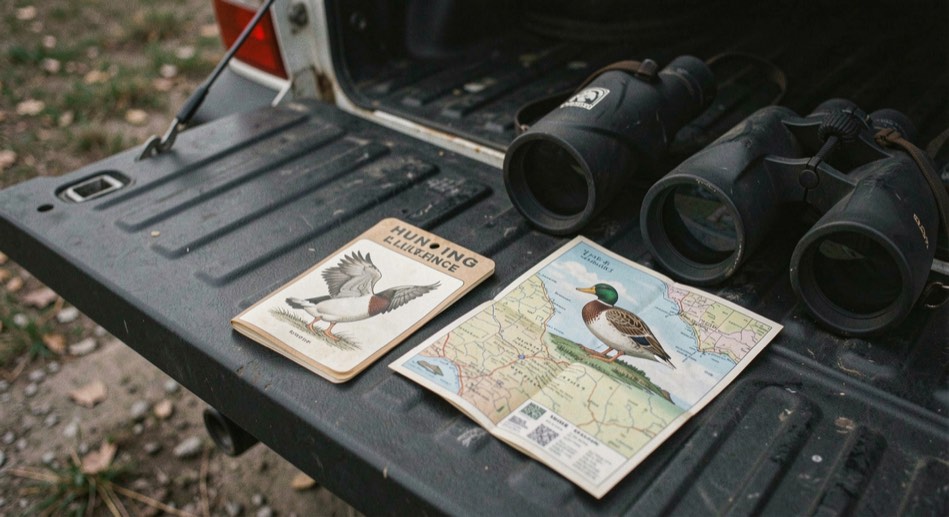
The hunting paperwork sounds like a stack and behaves like a sequence. Hunter education comes first, because in most states a first time hunter cannot buy a license without the card. The license comes second. Tags and permits come third, because they attach to species and units. Stamps come fourth for particular hunts, waterfowl above all. Get the order wrong and nothing behind it exists. This page walks the sequence once, with typical cost bands where fees are stable enough to band at all, and with the standing instruction that your own state booklet outranks every number here.
Hunter education: the card that starts everything
Every state requires proof of hunter education from most first time license buyers, with age thresholds and apprentice or mentored exemptions that vary. The standard course covers firearms safety, ethics, wildlife law, first aid and the survival basics, and it is offered as classroom, online plus field day, or full field formats depending on the state. Completion is typically recognized across state lines through reciprocal agreements, so one card serves a lifetime of traveling hunts. The card is a one time cost, commonly in the 10 to 30 dollar range or free in some states, and it never expires. Do it in the off season; class seats near openers go the way of ammunition.
The license itself
The base hunting license is the annual membership. Resident annual hunting licenses typically run about 20 to 45 dollars across many states, nonresident versions commonly 80 to 200 or more depending on the game and the state’s travel economy, and combination hunt and fish licenses usually beat the two bought apart. Small game, big game and migratory birds ride differently: some states sell one base license plus species permits, others price big game as its own larger license. Either way the license is a permission to hunt, not a permission to take; the taking is the tags’ business.
Tags, permits and the draw clock
Tags turn a license into a legal harvest, one per animal in most big game systems, and they come off two shelves. General tags are bought over the counter with the license. Limited entry tags are drawn, applied for months ahead, in the spring and early summer windows that the season calendar guide keeps hammering because the deadline is the whole game. Permit types stack by weapon and season, and some states run point or preference systems where patience is literally an investment. The rule that saves seasons: apply early, verify the unit, and never buy a tag for a boundary you have not read.
Stamps and registrations
Waterfowl carries the famous stack: the federal migratory bird hunting stamp, 25 dollars, required of adult duck and goose hunters nationwide, plus a state waterfowl stamp or permit in most states, plus the HIP registration that feeds harvest surveys. Some states add a pheasant or habitat stamp that funds exactly what its name says. None of these are large fees and all of them are earmarked, which is the quiet point of the whole stack: like the fishing license, the paperwork is the funding mechanism for the resource, described plainly on the fishing license cost page.
| Layer | What it does | Typical band | Clock to watch |
|---|---|---|---|
| Hunter education card | Unlocks the license for first timers | About 10 to 30 dollars, once | Class calendars, months before openers |
| Base license | Permission to hunt the year | About 20 to 45 resident, 80 plus nonresident | Expires on the state’s year, not yours |
| Tags and permits | Legalize the take, species by species | A few dollars to hundreds for premium draws | Draw deadlines in spring and summer |
| Federal duck stamp | Required for waterfowl, funds refuges | 25 dollars | New stamp each July |
| State stamps and HIP | Fund habitat, feed harvest data | Often 5 to 20 dollars each | Renew with the license |
The paper day checklist
- Education card located, photographed, backed up in two places.
- License bought before the opener, tags verified against the unit map.
- Stamps and registrations completed for every migratory hunt.
- Tagging and reporting method understood, pen or app both packed.
- Everything carried where the checkpoint conversation becomes a handshake.
Mistakes in the stack
The expensive mistakes are order mistakes. Buying the license before checking whether education is required, which strands the purchase. Buying tags for the wrong unit in a draw state, which forfeits the fee and the season. Skipping HIP because it feels optional, which it is not for ducks and doves. Letting the license year lapse in states where the year ends in March. And the quiet one: carrying everything except the tag, then filling a deer with nothing legal to notch. The stack exists to be complete, and completeness costs one evening.
The decision, plainly
Never hunted: book the education course first, this off season. Hunt every year: buy the combination license the week it drops, apply for draws on the framework’s clock, buy the duck stamp in July if waterfowl is on the calendar. Hunt out of state: budget the nonresident band honestly and read that state’s structure before applying. The whole stack, done once a year in one sitting, is a smaller task than one trip’s packing, and it is the only part of the hunt that is identical whether the season goes well or not.