Hunting Seasons
How to read a hunting season calendar
Every state publishes its seasons as a framework, not a list of dates: zones inside units, weapon windows inside seasons, draws and permits on their own clocks. Learn the framework once and any state calendar turns readable in an evening.
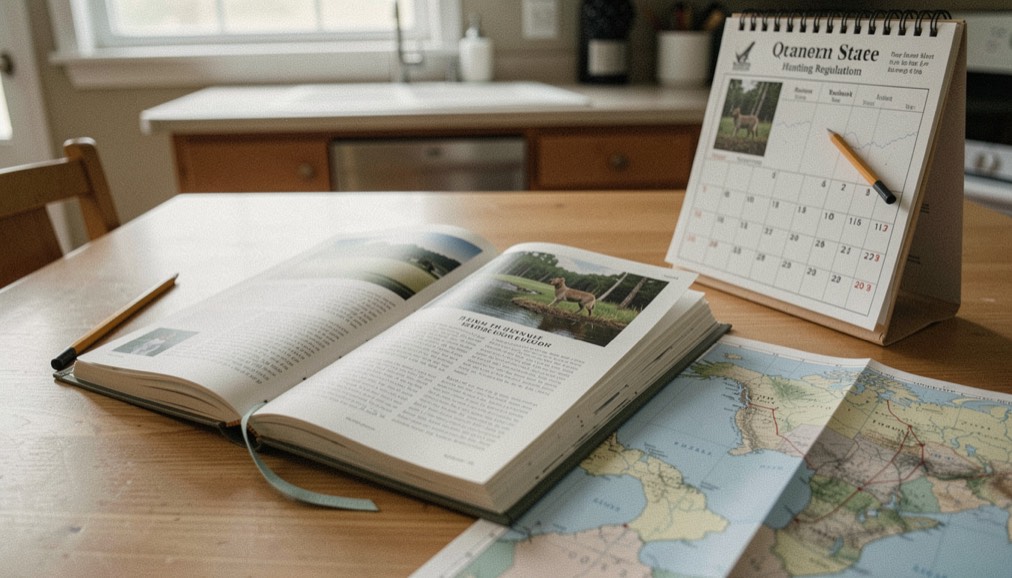
A hunting season calendar is not a schedule someone chose; it is a compromise the wildlife agency engineered between biology, politics and safety. Read it as engineering and it stops being confusing. Every calendar answers four questions in order: what species, in what zone, with what weapon, starting and ending when. Everything else in the booklet, draws, permits, limits, check stations, is machinery attached to those four answers. This page walks the framework and gives the typical frames by game so a first read of any state booklet lands on familiar ground.
The four layers of any season framework
Start with species, because each carries its own book: deer, turkey, waterfowl, small game and furbearers usually run on separate rule sets inside one regulation booklet. Inside each species sit zones or units, the geographic lines that change dates, bag limits and weapon legality from one ridge to the next. Inside each zone sit weapon windows, archery first, then muzzleloader, then firearm, sometimes overlapping. And inside each window sit the daily and seasonal bag limits that decide what a legal day actually looks like. Miss any one layer and a legal hunter becomes a case number; check all four, every year, because frameworks shift.
Typical frames, species by species
The windows below are generic frames seen across many states, written to help you recognize shapes, not to replace the booklet for your unit. Some states run earlier, some later, and waterfowl in particular bends to federal frameworks and zone lines that move.
| Game | Typical window frame | Notes that change the plan |
|---|---|---|
| Deer, archery | Mid September into November, often reopening December | Longest window, quietest woods, antlerless rules vary by unit |
| Deer, firearm | A short high pressure window in November, regionally variable | Blaze requirements and licenses sell out of goodwill fast |
| Deer, muzzleloader | A dedicated week or two, October or late season | Ignition and scope rules are state specific |
| Waterfowl | Late October through January in split segments | Federal duck stamp, state stamp and HIP registration stack up |
| Upland birds | Mid October through December, some into January | Public land bird numbers swing hard year to year |
| Small game | Early openers in September for squirrel, rabbit through winter | The teaching seasons, open when other woods are empty |
| Turkey | A spring window and often a shorter fall one | Spring is gobblers only in most frameworks |
Two clocks live outside the table. Draw applications for limited entry hunts typically close in spring and early summer, months before the season they grant. And hunter education, covered on the licenses page, must be finished before a license will issue at all in most states.
Reading the booklet in one sitting
Open the booklet to your unit first, not the front. Mark every window that touches a species you hunt, then read only those pages and write the dates onto a real calendar you actually consult. Note three fine print items while you are there: legal shooting hours, which usually run a half hour before sunrise to sunset; tagging and reporting rules, increasingly electronic; and the public land rules of any wildlife area you plan to walk, which can be stricter than the state default. The whole exercise takes one evening a year and retires every should have known conversation.
The pre opener checklist
- License and tags bought and in hand before the opener, not the morning of it.
- Hunter education card carried or on file with the state.
- Unit boundaries walked or mapped, with the private land lines marked honestly.
- Shooting hours, bag limits and reporting method written beside the dates.
- Blaze orange and any stamp requirements packed with the gun, not near it.
Mistakes the calendar punishes
The recurring failures are all framework misses. Assuming last year’s dates still run, when zone lines and windows move more often than hunters check. Confusing the species window with the weapon window, which is how archery hunters end up standing in a firearms season wearing brown fleece. Missing a draw deadline in June and learning about it from a stand in November. Treating a wildlife area’s special rules as optional. And the oldest one: reading the front cover of the booklet and trusting the summary table over the unit fine print, which is exactly backwards.
The calendar habit, in one paragraph
Here is the working method this whole site leans on. Once a year, the week the new booklet drops, read your unit’s pages and write the real dates on a real calendar. Buy licenses and apply for draws on the framework’s clock, not yours. Scout inside the window you will actually hunt. Then let the deer timeline, the small game primer and the license notes carry their own pieces of the plan. That habit, repeated, is what the phrase hunting season calendar should mean: not a lookup, but the spine of the whole fall.
Season windows rarely stand alone, and a retriever owner who reads the calendar closely will notice that training and testing dates often sit in the gaps between waterfowl splits and upland openers, which is why handlers who want to understand how those weekends are structured, from steadying drills to judged land and water series, can review retriever hunt test basics before mapping out a fall, keeping in mind that club schedules vary by region and are usually posted a few months ahead of the season.
A season calendar records dates, but a visual record of the year often proves more useful, so a few hunters keep a small camera or phone within reach and photograph each outing, then review the frames at dusk with a loupe and a stack of 4x6 proof prints, marking the contact sheet where weather, cover, and sign lined up, a habit that overlaps with editorial photography assignments and helps compare one season against the next.