Reading Water
Reading stillwater: lakes and ponds without current
A lake hides its current the way a river shows it, but the conveyor belt still runs, just slower and in circles. Inlets feed, drop offs funnel, wind lanes concentrate, and the shore you choose matters more than the fly.
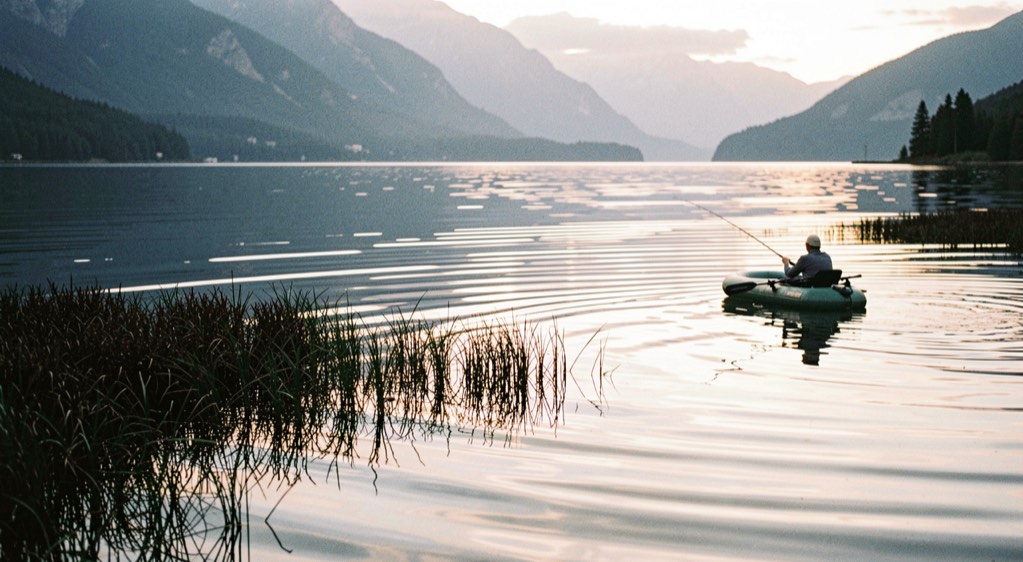
When the home river blows out or the season closes, the lake across the road keeps fishing, and most river anglers leave it unfished because it looks like a blank. Stillwater is not blank; it is a slow river with no banks to read. The current runs in layers and circles, food concentrates along lines the eye can learn, and fish patrol structure with the same energy arithmetic as a trout in a seam. Five features and one search plan unlock it.
The stillwater conveyor
Lakes move. Wind pushes surface water that must return underneath, warm layers sit over cool, and the whole slow engine gathers food along predictable lines. Fish in stillwater are cruisers: they hold near structure or food lanes and travel them on schedules set by light and temperature, the same bands the temperature page describes. The angler’s job is therefore not to find one fish but to intercept a route, which is why the bank you pick outranks the pattern you tie, and why the fly box matters less here than a watch and a pair of polarized glasses.
The five features that replace banks
| Feature | What it does | How to work it |
|---|---|---|
| Inlet | Cool, oxygenated inflow carrying food | Fish the current edge and the first drop off below it |
| Outlet | Funnel for drifting food, often a current seam | Treat it like river: fish the seam and the tail |
| Drop off | The shelf edge where shallow meets deep | Cast to the shallow side, retrieve across the lip |
| Weed line | Insect nursery, ambush cover, oxygen by day | Work the outside edge first, then the lanes inside |
| Windward bank | Wind stacks warm food rich water against it | Fish the shoreline the wind hits, not the one it leaves |
Wind deserves its own sentence because it looks like an enemy and behaves like a menu. A gentle to moderate breeze tilts the surface layer, and everything floating on that layer, midges, terrestrials, loose feed, collects downwind against the windward shore, where the cruisers learn to meet it. Anglers who hide from the wind fish the empty half of the lake; anglers who face it fish the cafeteria.
The search plan for a first visit
Arrive and spend ten minutes doing nothing but reading: where does the wind land, where is the color change that marks the drop off, which bank holds the weeds, is any inlet or outlet running. Then fish the most obvious feature first, in this order of usual productivity: running inlet, windward bank, weed line, outlet, drop off. Give each station a half hour of honest coverage with a slow, searching retrieve, generally a nymph or leech fished on a sinking or sink tip line, moving the fly slower than feels productive. Stillwater fish inspect; river fish decide. Patience is the retrieve.
Stillwater through the year
Lakes also rewrite themselves seasonally, and the search plan shifts with them. Spring finds fish shallow and near the warm banks, cruising just off the reeds, and the surface line matters more than depth. Summer pushes them to the thermocline and to dawn and dusk duty along the drop offs, when the day itself is the wrong hour. Fall turns the lake into a feeding race before winter, bait gathers in wind lanes, and fish chase higher and harder than at any other time. Winter, where water stays open, concentrates fish deep and slow, and the retrieve slows to match. The bank you ignore in May is the bank that fishes in October, which is one more reason the log in your pack is the best map a lake ever gets.
The stillwater kit note
- Polarized glasses, because depth is invisible without them.
- A sinking line or sink tip covers 80 percent of stillwater work.
- A few searching patterns: leech, bugger, nymphs in two sizes, plus midges.
- Anchor or drift bag for a float tube, and the flotation habits from the wading page.
- A log: wind direction, feature, depth, hour; lakes reward records even faster than rivers.
Mistakes the flat water tempts
Casting to the middle is the classic, the ocean of nothing between features; the middle is where fish are not, most of the day. Fishing the lee bank because it is comfortable, which is the wrong half by the wind’s ledger. Moving the fly like a river fly, fast and busy, when the take usually comes at the slow hang. Ignoring depth, since three feet of error is a miss even with the right pattern. And leaving when the river clears, which is fine, except the lake taught you structure reading that the river never will, and the currents page reads better for it.
The decision, plainly
When the river is high, muddy or closed, the lake is not a consolation; it is a classroom with fish in it. Read the wind, start at the inlet or the windward bank, retrieve slower than you believe, and log what works. The features transfer straight back to moving water, where a lake angler sees seams everywhere, and that is the quiet payoff: reading stillwater is how the reading water reach finishes teaching itself.