Reading Water
Reading river currents: seams, riffles and pools
A river is a delivery system: current carries food, and fish hold where the groceries arrive with the least swimming. Learn five features and one rule of energy, and every new river arrives pre annotated.
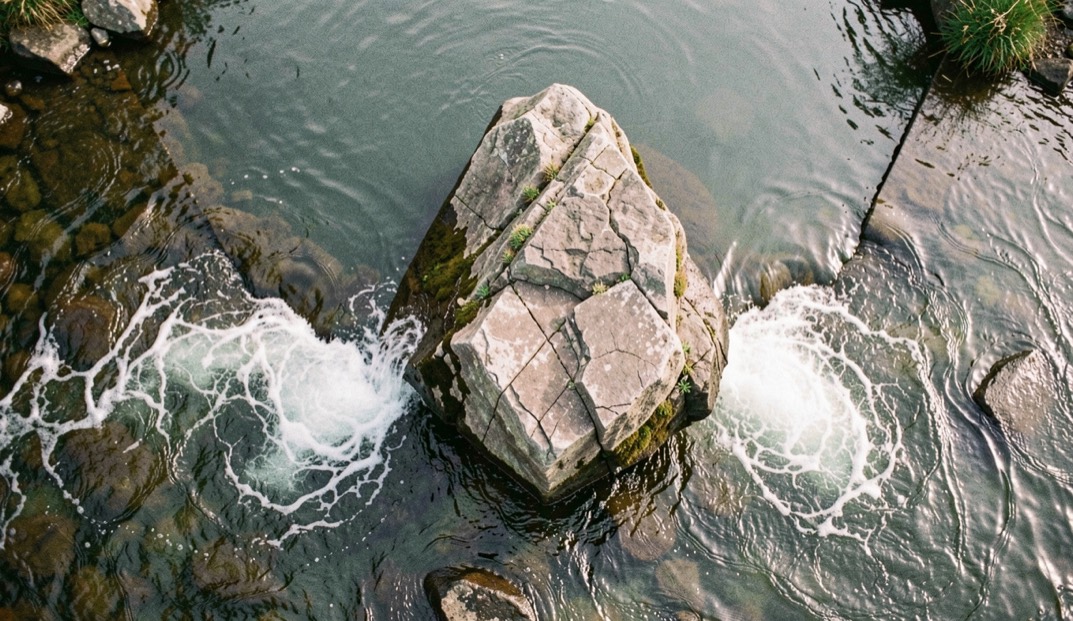
Reading water sounds mystical until you say what it actually is: predicting where the current delivers food, and where a fish can hold while collecting it. Current is a conveyor belt, trout are cash registers bolted to the floor of the store, and every feature on a river is a place the belt slows, speeds or folds. Five features cover almost everything you will wade past, and one rule of energy explains all five. Master these and the sport stops being a search and becomes a route.
The energy rule behind every lie
A trout holds where calories in exceed energy out, and the whole craft of reading water is that arithmetic. The strongest current runs near the surface and off the center of any bend; the bottom and the edges run slower; and behind every obstruction lies a cushion of barely moving water. Fish do not live in the fast water. They live beside it, beneath it, or behind something, at the seam where the fast lane delivers and the slow lane allows. That is why the question is never where is the fish but where does fast meet slow.
The five features worth a name
| Feature | What it does | Where fish hold | How to fish it |
|---|---|---|---|
| Riffle | Shallow, fast, broken water; oxygenates and hides | Close to bottom, behind rocks, often overlooked | Short line, weighted nymph, fish it close and quick |
| Seam | Boundary of fast and slow water | The classic lie: food lane beside a resting edge | Fish the line, one cast per foot, first passes count |
| Run | Even depth and speed moving downstream | Traveling and feeding lane, mid column | Cover methodically, swing or drift through the lane |
| Pool | Deep, slower water between faster sections | Tail in low light, head after food events, middle midday | Tail at dusk, head when hatch hits, rest the middle |
| Eddy | Slow water behind an obstruction | Rest stop and trash collector for drifting food | Fish the eddy line where it meets the main flow |
Read a single run with those five words and it becomes a sentence: riffle feeding the seam, seam feeding the run, run dumping into the pool, pool breathing out its tail. Every river you will ever fish speaks that sentence, over and over, in different accents.
Seams first, always
If the page had one command, it is fish the seam first. The visible boundary between fast and slow water is the highest percentage lie on the river because it does two jobs at once: the fast side delivers, the slow side permits. Approach from downstream or at an angle, throw upstream and across so the fly enters the fast lane and drifts the line, and give the first three feet after the seam extra attention, because that is where feeding fish station. Work the seam near to far and low to high, and resist the urge to wade into the lane you are about to fish.
Time of day moves the fish, not the map
The features hold still; the fish reassign themselves among them. In bright, pressured hours, the pool middles and the deepest seams hold the wary ones. At first light and dusk the pool tails and riffles come alive, because low light makes shallow water safe and the tail is where food funnels last. Cold mornings push fish to slower bottom water, which the temperature page quantifies. So the map stays constant and the schedule changes: same sentence, different emphasis, read through the hour you are actually fishing.
The bank survey, two minutes before every session
- Name the features out loud: riffle, seam, run, pool, eddy.
- Find the main seam and mark its first fishable third.
- Pick the approach that keeps you out of the lane: downstream or angled.
- Choose the fly for the depth the feature implies, per the hatch notes.
- Decide the exit before entering, per the wading checklist.
Mistakes the current punishes
The classic errors are all lane violations. Wading through the seam being fished, spending the lie to reach the lie. Fishing only the pretty pool while the plain run next to it feeds all afternoon. Casting across three conflicting speeds without a plan for the drag they create, which the guide teaching page calls the first correction in fly fishing. Ignoring pocket water because it looks busy, when each boulder cushion is a small honest lie. And fishing the fly only where the cast lands well, instead of where the water says the fish are.
The route, decided
Here is the working order for any new water. Survey from the bank and name the features. Fish the first seam within comfortable casting range, near to far. Move upstream one lie at a time, taking what the light and temperature give: tails and riffles early and late, depth and shade at midday. When the river blows out or runs still and shapeless, the stillwater page takes over. That is the whole method, and it is why this page is the one every other note in this journal quietly assumes you have read.