Gear Checklists
Fly fishing gear by budget tier
Fly fishing gear pricing is marketing with a rod rack attached. Three tiers cover the whole decision: a starter kit, a solid mid setup, and the level where money buys refinement instead of fish. The bands below are typical retail, checked against what actually lands on the water.
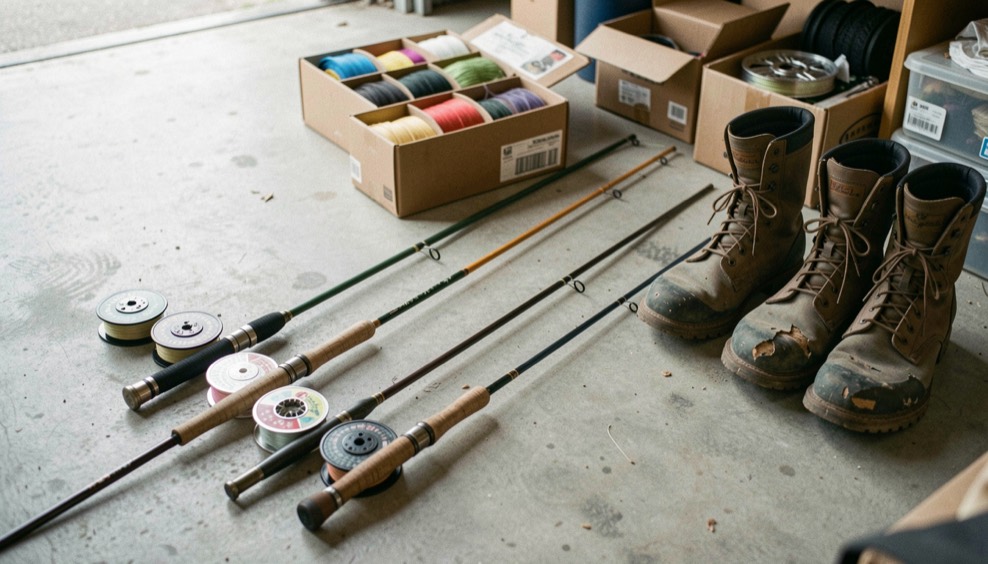
The fly shop wall makes gear look like a ladder you must climb, and it is not. A trout will not read your receipt. What matters is matching a rod weight to your water, putting decent line on a reel that simply holds it, and spending the remainder where it pays: line, leaders, boots and a net. This page runs three budget tiers with typical retail bands, explains where the money changes behavior, and ends with the checklist that keeps a first kit small enough to actually carry.
Pick the rod weight before the budget
The first decision is free: what water will you fish. A 5 weight is the all round trout answer for most of North America, honest at distance, gentle at close range, and available everywhere. Small overgrown streams flatter 3 and 4 weights; warmwater bass, pike and light steelhead work push to 6 through 8 weights; and two handers are a different sport with a different entry price. Buy the weight for your river, then the tier for your wallet. A 5 weight at any tier below catches the same fish on the same day; the tiers change feel, warranty and durability, not access.
The three tiers, honestly banded
| Tier | Complete setup band | What the money buys |
|---|---|---|
| Starter | About 150 to 300 dollars with line | A serviceable 5 weight outfit that catches fish and teaches casts |
| Solid mid | About 350 to 600 dollars | Better feel, lighter swing weight, real warranty culture, reels that seal |
| Committed | About 800 dollars and up | Refinement: recovery, craftsmanship, and a second outfit for a second water |
Read that table as where returns flatten. The jump from starter to mid buys the largest real improvement, mostly in how the rod feels for the two hundred casts a day you will throw badly at first. The jump from mid to committed buys joy, not fish, and it should be bought joyfully, late, and after the wading boots are serious.
Where the money actually matters
Four line items outrank the rod. The fly line, because it is the part that loads the cast, and a bad line on a good rod casts worse than the reverse; expect to spend real money there, typically 80 to 130 dollars for a quality freshwater line. Wading boots, because footing is safety, not style, per the wading safety checklist. Leaders and tippet, because the last three feet do the fishing, and fresh tippet is the cheapest fish catching upgrade in the sport. And the net, because a proper rubber bag net is both a landing tool and a release tool, which the catch and release page treats as the same thing.
The first kit, itemized
Beyond the outfit, the vest or pack needs eleven things and needs nothing else for a full season. Rod, reel, line and a spare leader. Tippet in two or three sizes. Nippers and forceps. Floatant and a small patch of dry flies, nymphs in two sizes, and one streamer. A spool of split shot or a couple of tungsten putties. Clip on a retractor, stuff in a rain shell, and stop there; every additional ounce is a decision you have not earned yet, and the budget tiers page you are reading is exactly where that discipline starts.
The parking lot checklist
- Outfit assembled, line strung, leader knotted before leaving the truck.
- Tippet sizes carried: usually 5X, 4X and 3X covers a trout season.
- Nippers, forceps, floatant in the same pocket every time.
- Net clipped where a landing hand finds it without looking.
- Rain shell and a dry layer, because the forecast is a rumor.
Mistakes the shop counter encourages
Buying the reel first is the classic; at trout weights the reel holds line, and almost any machined reel does that. Buying distance in rod form, a fast 9 foot cannon for a 30 foot river. Skipping the line in the budget, then blaming the rod. Collecting flies instead of tippet and water reading, which is the match the hatch page’s whole complaint. And upgrading at year one, before the caster, not the rod, was the limiting factor. Gear should lag skill by about a season; that gap is where teaching lives, per the piece on what a guide teaches.
The decision, in three sentences
New to the sport: buy the starter tier as a matched outfit, then a quality line and boots, and go fishing. A season in and hooked: move to the mid tier for the rod you actually reach for, and add the second tippet sizes. Ten years deep with money to burn: the committed tier is allowed, and so is a second weight for a second water. Every tier fishes; none of them fish alone, which is why the knots, the hatch notes and the currents pages all cost nothing and matter more than any receipt.